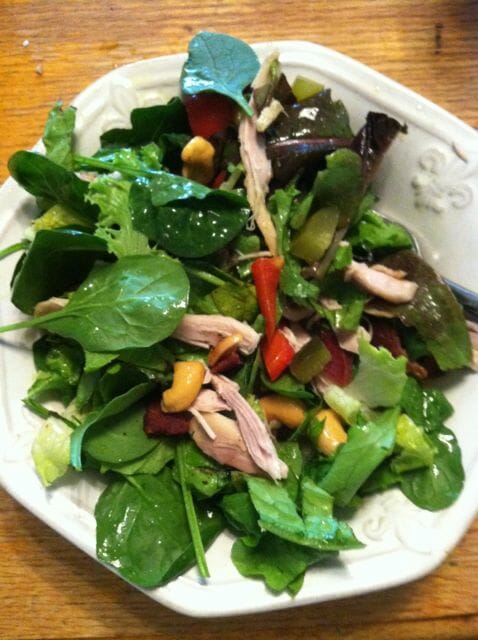
This is what I ate for lunch today: a large salad with lots of different greens, tomatoes, red peppers, carrots, oven roasted cashews, bacon slices, sliced up chicken from a roasted chicken, fermented pickles, cucumbers, and an olive oil and apple cider vinegar dressing. Afterwards, I was still hungry so I had hummus, gluten free crackers and red peppers.
One of the most common questions people have about going through a sugar detox, giving up sugar, or following a low or no sugar diet is, “What do I eat?”
While my focus is on healing your emotional dependence on sugar, and not your physical dependence on it (I’ll explain more below), the “what to eat” question is an important one, and one that you face every day, multiple times a day.
So I offer these meal ideas to show real life examples of how one person does it. I share what I eat as an example, not a prescription – these are not marching orders. And I share these meals in a spirit of reverence: of not demonizing any food, including sugar.
How sugar creates emotional and physical dependence
Our culture’s contemporary understanding about sugar and sugar addiction is based on the idea that sugar is an inherently addictive substance, and that eating too much (or any) sugar can lead to a physical dependence, addiction, or other health problems.
So most approaches to healing a sugar addiction focus on this physiological healing: healing your physical dependence on sugar by eating less or no sugar. This often includes a sugar abstinence or sugar detox.
Yes, sugar impacts your physiology. So yes, changing how much sugar you eat is important. And it’s not the full solution.
That’s because the physiological understanding of addiction is incomplete. (To learn more about this broader understanding about addiction, I encourage you to explore the work of Dr. Gabor Mate or read Johann Hari’s book, Chasing the Scream.)
It’s not just your physiology, your brain, or sugar’s addictive biochemistry that creates the cravings, addiction, and fixation on sugar. There’s also an emotional bond or dependence.
In truth, these things aren’t separate – there isn’t a split between the mind, the body and emotion. But our culture tends to focus on either the mind or the body and discount emotion. And so there isn’t an understanding of how emotion drives binges, cravings, and food and sugar obsession.
How an emotional dependence on sugar is formed
When most people explore their relationship with sugar, they find that their real “issue” isn’t with sugar at all – but how they relate to their human vulnerability, their pain, and their emotional, physical, spiritual, and relational needs.
The pain of these unmet, denied, and minimized needs is then translated into a strong emotional and physical neediness – cravings – for sugar. Sugar becomes your “best friend” or “mother” – where you turn to self soothe, numb out, soften stress, and care for pain.
From this perspective, the healing process with sugar is two fold:
- To connect. To relate honestly, tenderly, and compassionately to the unmet needs that lie underneath the sugar. As you care for these unmet needs, the drive for sugar softens. In this way, you’re not trying to cope with or manage cravings, you’re facing, softening and unwinding what drives and creates the cravings in the first place.
- And to grieve. To heal your physical dependence on sugar, you need to set a limit on how much sugar you eat. This limit can either be a sugar abstinence or a reduction of the amount of sugar that you’re eating. In either case, when you set this limit, you’re also letting go of your attachment to sugar and how you’ve relied on sugar to care for your needs. Severing this bond can bring up grief and sadness.
How “what to eat” fits in
In both your emotional and physical healing, you’re learning to rely on things other than sugar for emotional, physical and spiritual support, stress relief, pleasure, and pain relief.
So it’s a dance: to heal your physical dependence on sugar, you need to heal your emotional dependence on sugar. And to heal your emotional dependence on sugar, you need to heal your physical dependence on it.
It’s both/and, not either/or.
Every time you sit down to eat, you’re facing both your emotional and physical relationship with sugar. In fact, the act of eating invites you into this dance! That’s what can make meal times so potentially challenging – as well as incredible opportunities for growth.
Overfocusing on “what to eat”
Acknowledging that sugar addiction has an emotional component is important, because when sugar addiction is isolated as a physiological problem, it creates a polarization and a split. This split can lead to an obsession about what to eat and eating “clean” or “purely” and a demonization of sugar.
In other words, if the hammer is “sugar is a physical problem,” the nails are “what you eat, what you eat, what you eat.”
There’s much more I could say about why fixating on what to eat is simply another manifestation of the same addiction that drives us to sugar. But that’s a topic in and of itself.
How healing manifests as changes in what you eat
In my own life, I came to see that all my food compulsions – my addiction to sugar, my obsession with health and nutrition, my need to figure out the “best, ultimate” diet for my body, and my obsession with my weight – shared the same root. In other words, the answer to my sugar addiction was not a lifelong sugar abstinence, but to drain what drove me to seek out these food compulsions in the first place.
This is not to say that I didn’t need to learn how to eat and care for my body or change how much sugar I was eating – far from it. A substantial part of my journey entailed maturing in my relationship with food, and learning how to honor the limits of my body – including limits with sugar.
But there is a vast difference between honoring the body’s limits with sugar and fixating on never eating it.
This healing has helped me both relax about food and sugar (I consciously eat sugar today and enjoy a wide variety of delicious foods) and paradoxically, honor my body’s limits in what and how I eat.
The meals that I share below are the fruit of this learning, and the fruit of this journey, and the fruit of this healing. Enjoy!
Meals with meat:
- Grilled steak or chicken with grilled veggies and a big raw vegetable salad
- Roast chicken with green beans, salad, and curried vegetables
- Turkey meatballs, lentil dahl, lemon rice, and sauteed vegetables
- A giant taco salad with ground bison, guacamole, salsa, a huge bowl of salad greens, pinto beans, and sautéed onions and peppers
- Turkey sausages, homemade hash brown potatoes, sauteed greens and bacon
- Roast turkey with baked sweet potatoes, salad, and steamed broccoli with lots of butter
- Roast beef with tomatoes, onions, and carrots and sautéed squash (zucchini or yellow squash)
- Grilled salmon, a quinoa vegetable salad, and stir fry veggies
- Chicken salad with homemade, sugar free mayo and veggies on a huge green salad. (I make my own homemade mayo without sugar every week, and use it for all sorts of things, including meat salads. I use this recipe and omit the honey. )
- Bison steak, sautéed mushrooms, guacamole, a huge raw vegetable salad, baked yams with cinnamon and chili powder
- Chicken, salsa, guacamole, jicama, peppers, onions, tomatoes and garlic on a huge salad
- Roasted chicken thighs with olives, onions, garlic, diced tomatoes, and mushrooms; a large side salad; red potatoes
- A bunless hamburger with sautéed mushrooms, onions, lettuce, and tomato, a side salad, and homemade fries (I slice potatoes with the skin into thin strips, brush them with olive oil, and bake them in the oven.)
- A salmon burger (no bun) served with sauteed spinach and onions, a large green salad, and a baked potato
- Grilled venison, elk or buffalo with sauteed kale and onions, sauteed mushrooms, and gluten free crackers with a cashew dip
- Baked salmon with lemon juice, dill and soy sauce with sauteed swiss chard and a rice or quinoa pilaf
- Diced chicken with artichoke hearts and mushrooms in a creamy sauce; hummus and raw veggies; a side salad
- Stir fry veggies with chicken thighs
- A tomato or meat red sauce over gluten free pasta, baked spaghetti squash or squash noodles
- Every week I make bone broths and then I use them to make soups with a variety of veggies (including starchy veggies), greens and spices.
Meals without meat:
- Plain kefir or plain greek style yogurt with almonds, walnuts and ground flaxseeds
- Stir fried veggies with eggs
- An egg frittata with lots of sautéed veggies and pine nuts (I clean out whatever veggies I have in the fridge for my frittatas.)
- Baked winter squash with cinnamon and pecans and drizzled with flaxseed or walnut oil (I love this for a winter dessert.)
- Sauteed veggies and a baked red potato with butter
- Creamy millet (millet made with 4 parts water to 1 part millet) topped with butter and tons of sauteed veggies cooked in olive or coconut oil (This is comfort food for me.)
- Meatless soups – pureed squash soups, creamy tomato soup, gazpacho, lentil soup
Struggling with a sugar addiction?
If you have a painful, compulsive relationship with sugar, and want to unhook from painful sugar cravings, sugar binges, or an insatiable drive for sugar, I can help.
There’s a way to heal your sugar obsession so you’re no longer compulsively eating or bingeing on it – but the answer isn’t found in a perfect diet, will power, self control, behavior modification or even a sugar abstinence.
You heal a sugar compulsion by softening the heart, building emotional tolerance, by feeling cravings more, not less; through emotional honesty, and by healing the inner dynamics that feed the impulse to binge on sugar in the first place.
If you’d like to learn more, I invite you to join me for my 30 day program, Emerge. In this gentle, compassion based program, you’ll get 30 days of audio coaching to help you transition into a low or no sugar diet

Do you have a recipe book with your dressings for salad and the curried vege's? Those sound amazing!! 😉
Hi Robbie, I don't have a recipe for the curried vegetables. But I can share my favorite salad dressing with you here:
1 cup olive oil
1/4 cup vinegar (I use apple cider vinegar from Bragg's, but I've also used balsamic vinegar,too.)
1 tsp. dijon mustard
1-2 tsp. dried garlic
optional – finely diced herbs, to taste (such as basil, cilantro, thyme, etc.)
Pour ingredients in a cruet and shake to mix. Delish!
Thanks for all of the great information! If you are looking for meal ideas or meal plans, I have been using a website called FitClick. It is a great way to pick up some healthy meal ideas if you are looking to cut your sugar/fat.
Thank you for all of this wonderful information! Your meal ideas look amazing!
I am a real snacker… do you have any ideas on that?
Hi Jenna,
A great question!
I share some of my family's favorite snacks here –
http://www.firstourselves.org/what-can-i-feed-my-…
Some of my personal favorites are nuts – almonds, roasted cashews, pistachios, or walnuts. I eat them on their own, with berries (strawberries, blueberries, raspberries, or blackberries) or with plain kefir. I also love raw veggies and hummus.
But one of my favorite snacks isn't really a snack, per se – a bowl of soup. I'll eat soup for every meal, I love it so much. We pretty much always have a soup cooking in our house.
I hope that helps!
Warmly, Karly
Thank you for this article with its sensible advice. I started to eliminate sugar early in the month, and I've dropped 23 pounds so far. I may reach my goal weight yet! The information you gave is very helpful.
Yeah for you Maury – I feel so happy for you.
Warmly, Karly
Thank you for these meal ideas! I recently noticed that every time I eat sugar, I feel an intense itchiness and so I am trying to completely eliminate sugar from my diet. I thought I would only be able to eat meat, but it sounds like there are definitely some veggies that are ok. Thanks again for providing some healthy options!
Hi Karen,
Veggies are the primary component of my meals – I can't imagine feeling satisfied on any level without them. I feel glad you have other options, too.
XO, Karly
Thank you so much for this information. Your comment, “One of the reasons why I didnt want to give up sugar was because I thought that giving up sugar would mean having a joyless relationship with food where Id spend the rest of my days living like a food cop, neurotic and miserable. Ive learned to embrace this paradox:a joyful, loving relationship with food while also abstaining from sugar.” took the words right out of my mouth. I suffer from asthma to appoint lately my attacks are regular. I am am desperate. I was not born with asthma. I am not overweight and I am pretty active but this is getting in my way and the medicines I am on are not helping. I know I need to change something. But better yet I want to change something.I love food and sugar is my thing. So I I am going to do what you said and start slow, keep a diary and get to a point where my body will crave the foods, spoken by you that, “nourish your mind, body and spirit.” Thanks so much for this article.
We were told not to even have fresh fruit because of the sugar and I see your listing it……..little confusing. Do you have any snacks besides nuts you can recommend? Dealing with Pancreatic Cancer and was told no sugar at all. Little hard to wrap ones mind around no sugar. Seems to be in everything!! Thank you.
Hi Kathy,
First, I’m so sorry to hear about your cancer. It sounds like you are doing lots of things to care for yourself.
Yes, it is confusing about what is or isn’t “sugar free” – different people define it in different ways. I do eat fruit in moderation – but that’s what works for me and my body. I probably eat more of a zone type of diet (40% carbs/30% fat/30% protein.)
My area of expertise is the emotional component – not the “what to eat” piece. So if you’re needing help on this, I’d encourage you to seek out a nutritionist or other expert who can help you determine what sugars you should avoid so they can better meet your needs.
I actually find that when I eat meals that have a good amount of fat and protein in them, I don’t need to snack – I eat 3-4 meals a day instead. So I eat mini meals for snacks.
I hope that helps!
Warmly, Karly
Hi Karly, just wondering what an ordinary breakfast might look like for you- love my fruit for brekky!!
Hi Meg,
My breakfasts look a lot like lunches or dinners. This morning it was some ground beef with sauteed veggies in olive oil and butter (cabbage, onions, carrots and sweet peppers with some fermented pickles on top.) I know this may sound odd, but this kind of breakfast makes me feel very grounded, satiated and full for hours.
I know plenty of people who eat fruit smoothies with added protein in them, and feel great. So perhaps that's a way for you to enjoy your fruit in the morning?
Or if you're okay with dairy, some plain greek yogurt with nuts and fruit?
I hope these ideas help!
Warmly, Karly
Thank you for this, I was just diagnosed with Melanoma skin cancer and told to take sugar out of my diet as well as meat. This has been very helpful to me as well. Breakfast is the hardest meal for me to fine things to eat as well but your ideas helped, a lot.
hi there, I love your article and the advice is amazing… I am on week 3 of no sugar and by no sugar I mean sweets, junk food, pastries, chocolate, refined sugar, corn syrup, maple syrup, honey etc. I have not eliminated any fruits as I feel fruit has helped me along the way and I love them… so pretty much my question is this, when we say sugar free are we suppose to be eliminating fruits as well? it seems wrong as they provide lots of valuable nutrients and vitamins.
I’ve read butter, oil and meat cause high cholesterol, heart disease and cancer so therefore I haven’t had any meat, butter, oil. But I do eat lots of sugar, through fruit and breads, pasta, and rice. I’m now confused with this information.
Hi Vivian,
Yes, there is so much contradictory nutrition information out there, and it can be very confusing and anxiety producing.
I don’t write about the ‘what to eat’ question anymore in my work, as I focus on helping people their emotional relationship with food.
I’m guessing that a nutritionist or medical expert might have some thoughts to share on what to eat. I personally like the work of Marc David and Sally Fallon, although you may find someone who’s a good fit for you.
Nutritionists/doctors that work specifically in the area of sugar include Jonny Bowden and Dr. Mark Hyman, and they might be a help.
Warmly, Karly
I am in week 1 of my sugar-free diet. I stopped using sugar, in any form because of anxiety. I was told, by an Integrative Medical Practitioner that sugar causes a spike in cortisol, which then causes anxiety.My days haven't been anxiety free, but they have been better.
I am on anti-depressant medication, after having been hospitalised for anxiety.
Hi Louis,
I didn’t know that sugar can cause a spike in cortisol, but as someone who’s had lifelong struggles with anxiety, that makes so much sense to me. Thank you for sharing that with me.
I’m glad that the anxiety has lessened for you now that you’re eating less sugar. In addition to writing about sugar, I’ve also written a lot on First Ourselves on softening anxiety, and have a hunch these posts may resonate with you:
http://www.firstourselves.org/allowing-our-feelings/
http://www.firstourselves.org/soothe-reactive-brain/
http://www.firstourselves.org/loving-where-youre-at/
In love and care, Karly
Karly, I've been refined sugar free and gluten free for 3 months now. I've dropped 15 pounds and feel great but I am now finding it hard to maintain my weight. It just keeps dropping no matter how much other food I eat. I don't want to increase my fat in take too much so that I stay heart healthy. Any suggestions?
Hi Marylou,
How wonderful that you're feeling so well! As to what to eat to help maintain your weight, I need to be honest and share that this isn't my area of expertise. My friend Andrea at True Nourishment may be able to help with this question – http://truenourishment.com/ or Csilla at Shining Health – http://www.shininghealth.com/ In love and care, Karly
I had to give up all sugars, including foods that convert to sugar quickly in the body – like potatoes- in order to cure my long term systemic candida.It was hard going for a bit, but now I am really in fantastic health and look and feel better than I did a decade ago. The book "sugar or sex", it's diet guidelines and the other support that it suggests really helped me. If you are suffering from hard-core candida problems or need to eat completely sugar free, including fruit and grains and everything, I really recommend this diet and approach. I worked really well for me. I had tried so many other methods over years, and none of them gave me a long term cure. But Sugar or Sex really worked. thanks! May
Thank you so much for posting this, I am dealing with the same thing and it’s nice to have a book recommendation in addition to the hours of internet surfing I have done one it.
Hi April,
I’m so glad! If you’d like to learn more about what I do or how I can help, my focus is on healing the emotional and psychological roots of sugar addiction and eating disorders, something above and beyond managing or “controlling” the cravings or behavior itself. You may find this webinar helpful, where I map out what drives sugar addiction: https://growinghumankindness.com/webinar-replay-wfiym-140109/
In warmth and care, Karly
Hi May,
I'm so glad that the book was helpful to you. There are so many great resources out there for sugar addiction, and it sounds like you found one that was a good fit for you.
Warmly, Karly
I'm on Day 7 of detoxing from sugar. It has been surprisingly easy, but I was already eating the way you suggest. I just binged every night on sweets when I finally relaxed for the day with my guilty-pleasure mystery novels. I used to be a vegan, but like you I just seem to have to have animal protein, even if it's just a cage-free egg or a free-range chicken breast. Thank you for validating that some of us just aren't cut our to be vegans. Also wanted to share something that I believe you mention in your first book, but now when I get a sweet craving at night, I ask myself if it's really worth a few minutes of pleasure to start my next day out waking up with guilt and shame over the night before. This works for me, but I wonder how long it will be before I get resentful and give in. Guilt and shame are not good reactions to food or to oneself, I'm sure. Any suggestions for rethinking this?
I’m about to start my sugar free detox tomorrow and have been scouring the web for info about meal plans and ideas for a successful detox. I must say this has been one of the most helpful sites I’ve stumbled upon. I’m looking forward to the challenge and will drop by in 21 days to let you know how it went.
Cheers,
Doni B
Hi Doni,
So glad this is helpful to you! I tip my hat to you as you go through your sugar detox.
My focus is on helping you with the emotional and psychological aspects of change, including transitioning into a low sugar or sugar free diet. I’d love to point you to some resources that I offer that might help –
How to eat less sugar without white knuckling it – https://growinghumankindness.com/eat-less-sugar/
If you’re wanting emotional support, I’ll be leading a group through The 30 Day Lift, my 30 day program to switch to a lower sugar diet, beginning the first of May. This program uses self compassion and insights from developmental psychology to support your transformation. You can learn more here: https://growinghumankindness.com/30-day-lift-intro/
I also like Diane Sanfilippo and Dallas and Melissa Hartwig’s work on the “what to eat” question – they have much better knowledge on the food and what to eat question than I do. You might find their work helpful.
http://balancedbites.com/
http://www.whole30.com/
I’d love to hear how your 21 day experiment goes!
In warmth and care, Karly
Recently I successfully completed the 21 day sugar detox and surprised myself that I made it through. Days two and three my body fought hard for sugar, but I made it through (mind over body?). The hardest part was shopping every few days for fresh veggies and preparing food in advance for lunch at work. The results were more energy, no gas or bloating, more restful sleep, and the best part of all was to be pain-free. It is difficult to explain, but my body is “achy” pretty much all the time. I have always attributed it to age (I am 65) and something one must learn to live with, along with alieve and ibuprofen. It has been six weeks since I did the detox and I am now back to my old ways of eating whatever I want AND once again in pain. I now know it isn’t necessarily age, but what I eat. My choice is to eat what I want and be in pain or change what I eat and how I think about food (comfort versus survival) in order to be pain-free. Sugar is a drug and when we eat it in foods our body craves more!
Hi Barbara,
Thank you for sharing your story here. Like you, I regularly make the connection between what I eat and how I feel. Sometimes, this connection is a humbling, gentle reminder that certain foods don’t make my body feel good! It’s a journey of love and learning, isn’t it? Love, Karly
Let us know
Hi mine is a question! I have celiac disease, but I am very active. I weight train 3-4 days a week! Since being diagnosed with celiac I can’t seem to regulate my weight! A member at my gym told me her story of being sugar free dye to Candida! I performed a test at home which, indicated I did have, Candida! I would like to go sugar free it close to it, without sacrificing energy in my workouts, and keeping and draining more lean muscle! I am so confused as I’ve read, and heard so many stories regarding a sugar free diet! Yours is very close to my story, with some small differences! My celiac, and auto immune problems( doc had me off dairy as well), could you please, please help me with this dilemma, as I am so lost, and have added on extra fat, to an already small frame! I am so unhappy and confused!! Please, can you help me?
Blessings,
Marnie
Hi Marnie, Thank you for writing! The “what to eat” question can be very confusing, for as you pointed out, you could talk to 10 experts or nutritionists and get 10 different answers. My focus is on helping people heal the emotional roots of sugar addiction and food compulsion, so I’m not the best person to answer the what to eat question. I can direct you to some resources who may be able to help – try Donna Gates’ body ecology program, as I believe it’s gluten free and addresses candida issues. You may also reach out to Diane Sanfilippo’s work, as she has a nutrition background, as well. I hope that helps and wish you the best on your journey. You can learn more about their work here:
http://bodyecology.com/aboutbed.php
http://balancedbites.com/
Warmly, Karly
I’m sixteen and a junior in high school. A girl in one of my classes was giving a speech on why she did not eat sugar anymore and i realized that i wanted to stop as well. Ive been researching all week but i can not seem to find many foods that have no sugar except eggs and meats but im not a huge fan of meat. I dont wanna starve myself but i do wanna eliminate sugar completely from my diet. Can you email me ideas? Katnicsem@aol.com
Thanks c:
Hi Katie,
Thank you for writing! It sounds like you are wanting to make healthier food choices and are interested in learning more about nutrition. And it sounds like you’re trying to eliminate all forms of sugar – even natural sugars, like the sugar that naturally occurs fruit and vegetables – vs. foods with added sugar in them.
I would gently encourage you to soften this.
I don’t think it’s necessary to give up all sugar to be healthy – in fact, in my own life, I focus on eating less sugar rather than giving it up completely, because trying to eliminate all forms of sugar can turn into an eating disorder or an unhealthy compulsion around food, where you’re fixated about how much sugar you are or aren’t eating.
For most people, reducing how much added sugar they eat – things like sodas, energy drinks, candy, pastries, ice creams and sweetened coffees – is a much more sustainable ideal than giving up all sugar. But they continue to eat foods like fruits and vegetables that have natural sugars in them. (I eat a ton of vegetables in my own life!)
I’m a momma to two teenage girls, and I can share how I feed them: I give them lots of fresh whole foods at home – dishes with veggies, meat, brown rice, warm soups, big salads, eggs and turkey sausages and potato patties, lots and lots of veggies, brown rice, whole milk. And they do have treats – chips and salsa, ice cream, apple cider, homemade fruit crisps and muffins. I don’t give them sodas, caffeine or buy candy, but I know they enjoy sodas and coffee every now and then when they’re out with their friends, and they also will buy some candy with their allowance. I think this balance is a good one and not too extreme. I look at it as I fill them up with nutritious food much of the time, and that there is also a place for some treats.
Perhaps this is something that would also nourish you in body, mind and spirit.
Much love, Karly
Hi everyone.
I tried a diet a couple of years. The diet was created by Diane Sanfilippo, if anyone knows her. My experience was good, I got 20 kilos slimming. If someone wants info: http://bit.ly/1kOqaF4
Hi Carmen,
I’ve heard good things about Diane’s work! I’m glad you found it helpful.
Hi dear! I would like to ask you about these sugar free food. Well, I’m on week 2 without any sugar on my meals. But since yesterday, my body really want to have something with sugar in it. i didn’t eat any fried foods anymore (fried chicken etc.) i only eat baked foods or freshly vegies and fruits. I’m so stressed right now because I really want to loose my weight but i don’t want to ruin it just because of my craving. Any suggestions?
Love, Xyra
Hi Xyra,
Many folks, when trying to lose weight, try to eat less sugar, because they’ve heard that too much sugar can lead to weight gain. Of course, if you’re trying to stay away from sugar, than cravings can be scary, overwhelming and frustrating!
What I’ve found to be much more doable (and gentler to the heart!) than trying to eliminate it completely is to focus on creating a more conscious relationship with sugar. When folks are trying to create a more conscious relationship with sugar, they may find that, in the beginning, it’s helpful to eat less of it, or to eliminate it for a bit.
But this is a stage, and not something helpful or necessary over the long term.
Trying to have a more conscious relationship with sugar (rather than abstaining from it completely) brings much more ease and possibility to the heart! That’s because it gives you the mercy and the room to transform how you crave, eat, or desire sugar rather than feeling like you have to walk on the “no sugar” tightrope all the time.
Here are some links to some posts that can help you create a more conscious relationship with sugar and feel more comfortable and less afraid about cravings.
How to eat less sugar without white knuckling it: https://growinghumankindness.com/eat-less-sugar/
Healing the shame of craving – https://growinghumankindness.com/healing-shame-craving/
How befriending emotions can help soften sugar cravings – https://growinghumankindness.com/healing-sugar-addiction-emotions/
May your journey have ease!
Warmly, Karly
My doctor told me I was pre diabetic and to go on a sugar free diet don’t have any idea of how to get started .I drink coffee in the morning and tried to drink it without any sugar but couldn’t. I only drink one cup in the morning with 1 tsp of sugar . That is the only thing I put sugar in I don’t eat a lot of sweets every so often I will grab something sweet I eat a lot of salads but not the right types of dressing I am 69 I really need your help to start in the right direction I work over night feel really great for my age no pain and I want to continue. What do you suggest for me to do.
Hi Cora,
Dietary changes can feel overwhelming at first, can’t they? It sounds like you’re needing some help on the nuts and bolts of what to eat! You may want to check out nutritionist Dianne Sanfilippo’s work, as she’s a great resource for this. She offers free food plans, menus, grocery shopping lists, and more that will make the transition much easier for you. Learn more at – http://balancedbites.com/
Warmly, Karly
Ok, all of this sounds fine and dandy but PLEASE, I BEG… how in the world can you change someone’s diet when they don’t like anything that is good for them? My husband takes all kinds of meds for hypertension, pre-diabetes, high cholesterol…etc. He’s 5′ 7″ and 245lbs- has been for the 7 years I have known him. He can’t eat chicken (he likes it but it doesn’t like him), hates all fish (except baked fish sticks), he does like salad-sans dressing but won’t eat it if it doesn’t have bacon bits and shredded cheddar on it, doesn’t care much for ANY type of “ground” meat (turkey, venison, bison or beef)-he will eat them as a “whole meat”. . He is ADDICTED to bread, white rice, potatoes(white not sweet unless they are candied),crackers (saltine), pasta (NOT whole grain), mostly PIZZA. I have tried for 7 years to fix healthier versions of food he likes to NO avail. He does drink water but insists that some meals make him sick if he drinks water with them (it’s true) and must have a can of Pepsi. The hardest part is he won’t eat breakfast and packs his lunch every day but often works 12+ hours so he relies on a lot of processed pre-packaged crap that won’t spoil while he’s at work, where he is an inspector and always on the go… I absolutely hate planning meals and going grocery shopping because I simply can’t eat the way he does and it isn’t beneficial to cook more than one meal almost every night. Someone…ANYONE… PLEASE ADVISE!!!
Hi
I am wanting to give up sugar, I do eat quite healthy apart from biscuits and crisps. But my biggest vice is alcohol. Is there anything I could drink, like maybe a vodka and soda?
Thanks
Hi Mandy,
This is a great question! Unfortunately, I’m not a nutritionist, so I don’t know that I’d be the best person to ask about alcohol and sugar. I do have some resources that can help. I personally don’t drink, as I don’t like the taste. But I understand that’s not the case for lots of people.
http://www.sugaraddictstotalrecovery.com/7-steps/overview/
http://www.sugaraddictstotalrecovery.com/7-steps/getting-started/
https://www.womentowomen.com/insulin-resistance/having-a-sweet-tooth-fact-or-fiction/
http://pubs.niaaa.nih.gov/publications/aa26.htm
Warmly,
Karly
Is there away to have no sugars at all? Like not even natural sugars?
Hi Scarlet, I think there are others who talk about how to do a complete sugar detox. I no longer focus on a sugar abstinence in my work, but on healing the roots of food compulsions in general. Try Dr. Mark Hyman’s work – I believe he talks about detox programs where there are no sugars. Warmly, Karly
Hi,
I have tried Weight Watchers, Jenny Craig, Nutrisystems, and other forms of books.
I just find that all the recipes they supply are way out and would cost me a fortune to prepare all the time.
Foods from companies that supply foods do not seem to teach me anything as to what I should be learning to eat.
I put all my weight on in my belly section and I hate myself when I look in the mirror. I just want to eat healthy. I have high chol.and blood pressure probably because of this so I am ready to try find something somewhere that I can follow and make foods easy for my hubby and I. thanking you, Christine
Everything looks great. I keep trying to click the mayonaise recipe and it keeps taking me to a website about walking barefoot?? A little confusing for a non technical person.
Hi Russell,
Thank you for writing and letting me know. It’s possible the URL has changed for the mayo recipe and the link no longer works.
Here’s how I make mine:
I add 2 egg yolks, 2 1/2 tsp of lemon juice, 2 tsp of apple cider vinegar, and 1 tsp of celtic salt to a blender. I blend it together for 30 seconds or so. Then I slowly add in 1 1/2 cups of extra light olive oil to the mix in the blender until it emulsifies.
I like to use extra light olive oil because it doesn’t create a strong olive oil flavor in the mayo. Sometimes I use walnut oil or avocado oil as well – it’s a personal preference.
This amount makes a double batch – I use this mayo base to make salad dressings, flavored aiolis, and as a mayonnaise itself, so I always make a double batch when I make it. The other day, I added some pureed, roasted garlic, fresh basil, and apple cider to the mayo to make an incredible creamy garlic dressing. Then again, I am part Italian, so anything with garlic and basil gets a star in my book!
I hope you have fun with your mayo creations, too.
Warmly, Karly
im doing sugar free Febuary. and I was wondering if you could send me Some Foods I can have that dont involve sugar please
Hi Gemma,
Thank you for writing! I help people with the ‘inner healing’ that unwinds a sugar addiction – so I don’t specialize in figuring out the ‘what to eat’ question. You may try instead Kathleen des Maisons work (she wrote Potatoes not Prozac), Mark Hyman’s work, The Whole 30 Diet, or The 21 Day Sugar Detox Diet – they can help you with meal plans and food suggestions. You’ll find links below:
https://21daysugardetox.com/what-is-the-21-day-sugar-detox/
https://radiantrecovery.com/7-steps/
https://www.doctoroz.com/article/dr-mark-hymans-sugar-detox-plan
https://realplans.com/whole30/
If you’re wanting help with the emotional side of a sugar addiction, that’s where I can help. You can learn more about the kinds of support I offer below, including a 30 day support program:
https://growinghumankindness.com/30daylift/
https://growinghumankindness.com/sugar-support/
I wish you good health and success on your detox!